Wednesday, June 30, 2010

POOR IS THE NEW RICH


The smart company magazine echoed these words.This brought me thinking of the so called "rising economy" Kenya is experiencing.
Is it that the Kenyan economy is on the rise among the rich only?A "mama mboga" in Mushatha will tell you ,"Maisha ni makumu,sibati hata engang'a " to mean that she does not experience the joy of the rising economy.

The tycoon in the city when asked of how the Kenyan economy is fairing, will say "I don know but I think we are doing pretty well ya".He then adjusts his sleeves and walks away in a swagger.

That's how it is..

Even companies and manufacturers are targeting the low income earner.An excerpt of the smart magbiz said"
They go to the shops with just enough money to get what they need for the day. Not that they will not need the sachets of cooking fat or piece of soap worth Sh5 tomorrow, but because that’s all they have at the moment. These are the poor who make about half of Kenya’s population. This group has become the favourite of goods manufacturers and service providers, who have repackaged their products into the smallest possible quantities produced in huge quantities.


Even goods that previously seemed to target the higher income groups, with premium prices, like instant coffee, medicated bathing soaps, bleaches and insurance, among others, are being made accessible to the not so rich. Big service providers are repositioning products to reach the masses. Insurance companies, banks, mobile phone operators and internet services providers are all in a rush to get a share of the lowest economic group."
 
I believe for us to achieve 2030 vision as a country,there has to equitable distribution of resources especially from the grass-root level.

Tuesday, June 29, 2010

TO BE APPRECIATED.

O God of all creation
Bless this our land and nation
Justice be our shield and defender
May we dwell in unity
Peace and liberty
Plenty be found within our borders.

(verse:2)
Let one and all arise
With hearts both strong and true
Service be our earnest endeavour
And our homeland of Kenya
Heritage of splendour
Firm may we stand to defend.

(verse:3)
Let all with one accord
In common bond united
Build this our nation together
And the glory of Kenya
The fruit of our labour
Fill every heart with thanksgiving.

STORIES I TRY TO REMEMBER.

The best times blur in remembrance; it is the painful ones that have stayed with me. Long days of seeking and not finding; of empty pursuits thrust into perpetuity. Hard, cold nights of catching moonbeams through an ageing roof. Some nights the full moon, hanging low in the sky would turn an eerie shade of red, the wind would blow malevolently against the tin (or the mad and wattle depending on where we lived then) walls and dark clouds creep on the moon; smother her light and loll over the sky an ominous rumble in their wake.

Then it would begin to rain.

To remember it all brings tears to my eyes- these tears do not rain, they pour. In private, in between spotless white linen, I curl myself into a foetal position and let the sheets mop up more fluid than they have from all the trysts they have seen lately. Those are my only moments of truth; times when the uppity conversations in mood lit rooms are done and I have no one to go home to.

In those days, the conversations would have been harsh- held in coarse tongues over ugalisukuma wiki  but at least there would have been someone to go home to. You would always return to your brothers' drunken snoring as they lay sprawled over the Vono single-bed. Or maybe it was one of your relatives from the village; an old mate from high school. Someone. Sometimes all these people would be all in there, sober and hungry, hurdled over the charcoal brazier telling war stories. Other times there would be nobody and you hoped for the best: that at least they were spending a night at the police station.

The Police station... nyumba ya mawe kizee!
Yes and the police station came with security. Security from our biggest fear: The Police. If you were spending a night at the police station it meant that they had caught you alive. And that, I kid you not, was a rare occurrence. Most important of all, the police station, for those who know its ways, came with a guaranteed breakfast. Scalding tea and a measly slice of bread after a night of cat naps in a crouching position might not seem like much but it was divine compared to the air burger breakfast at home.

In the morning, the OCS (Officer Commanding Station) would put you to work sweeping the police station's compound and send you on your way. They knew those who could be bailed out and those who couldn't. And you knew that they wouldn't bother taking you to court on charges of 'idling' because that was a charge they preferred on those they hoped to extort money from. Money which they knew you didn't have. Set free you returned to the same emptiness- to the constant struggle in search of any means of escape from poverty. In most cases the only means to be found was through cheap drugs and alcohol.

I say these things now because the soft voice that has been whispering in my year for over a year has turned into a yell. When I started this blog, it was because of two things. First I knew I had a story to share. I did not know how well to tell stories, but I had more stories then than now. But stories do not go away, they live in our hearts but the desire to rewrite history and escape its lowest moments thrusts us into the murky depths of forgetfulness.

The story I wanted to tell was that of a mid twenties Kenyan guy trying to afford his next shot of moonshine; his urban escape vehicle. About the realities of a life of fruitless striving and the ways we tried to escape it. It was about how life was and still is in that small theatre of broken dreams that is our end of Nairobi. The story of an urban space and a people who only live in NGO statistics and the dispatches of foreign correspondents. I wanted to imbue this space with character, take away the jaded and callous ways real people were constantly reduced to objects to which a subject (war, hunger and pestilence) and a verb were added to complete that 'balanced' news story. I meant to take away the emasculation of a people through turning them into data that fit well into a pie chart in a funding proposal. I desired to translate the lived experience into the written word. Maybe in the process of transferring life into words, I would be discovered as a writer.

The being discovered as a soft-spoken motivational speaker was the second reason I started doing this blog. These days they call me a blogger,this is a little bit more advanced. But how can I be an accomplished blogger while the story that made me languishes in oblivion? Without the Kenyan Urban Narrative, I am incomplete.

I write these words now because, lately, I have been thinking about truth and forgetfulness. The written word has been for centuries, now, the most efficient way of documenting and preserving truths. Books, nay, written words have an element of permanence, they immortalise the author and grow the database of the record of a human existence. Our existence. What is written now affects what we think tomorrow. Yet all that is written today is not of necessity true. And some of those falsehoods are peddled purposely. The purpose is never, out rightly, to deceive but merely to add drama to mundane experiences.

Mainly, I am talking about the Memoir here. It is amazing how many autobiographies are being called to question in recent times. Forget about the blatant inventions of Margaret Seltzer aka Margaret B. Jones in Love and Consequences, Misha Defonseca in Misha: A Memoire of The Holocaust Years, the Oprah-Bubble-Busting James Frey and the like but the accusations of embellishment and anachronism in say Ishmael Beah's A long Way Gone. If such accusations can be true, can these narratives be seen to have been ruined by a desire in the publishing world to publish what is sensational, if badly told, rather than what is mundane yet well and truthfully narrated? Are readers more interested in the humanity of their subject or in their celebrity, infamy and vileness? Are stories of every day, forgotten people remarkable out of once-in-a-while news features?

Can the Kenyan Urban Narrative be told for and as what it is- a lived experience- and continue to appeal to its audience and the world that does not know the story?

Most important of all, how much can its author remember? How much of story is there without the detail? Is the accuracy of time vis a vis incident relevant or is placing real incidents in wrong times a misrepresentation of fact enough to push the narrative into the realm of fiction?

Such have been my thoughts for long days. I have many answers from the ethical to the philosophical but what I have realised is that those answers are not necessary or in anyway related to what I set out to do. Not, at least, in the most fundamental of ways which is whether or not this blog can give voice to a disenfranchised majority. To my own self, then, I shall be true and return to the neighbourhood. Shed this ridiculous pandering for literary greatness that is lived more in association that in works published. and

 I want to go back to those days, when the writing was cathartic. To that place where words were the best way to escape that low moment when the alcohol and drug buzz is worn out and you know not where your next high is coming from. I am going back to a time when I wrote and wrote, grinding pencil lead to a pulp and wearing out exercise book after exercise book right through to the margins just to still the demons and wait out the unpredictable.

I am going back to the Kenyan Urban Narrative. At least to the least of it that I can still remember.

WHY WRITE?

I write when I am challenged and the only place to tell it all is here.
When many of my aspirations seem like they are all going haywire and the whole world does not really seem to understand what is going on with me.

.....otherwise I write when I cannot actually tell the world all my happy moments


...so catch me on every life moment..

.........because we share......

CHAPTERS OF MEMORIES

 To my departed friend,

These tears have been flowing since yesterday. I have tried to wipe them off with jug after jug of Senator but the only thing I have managed to still is my cash flow. Now I am sitting on the dirt floor surrounded by books and half drowned in my own tears. I am holding a dog-eared copy of THE MERCHANT OF VENICE with one wobbly hand and writing you this note with the other, more wobblier, hand.

Surrounded by books, huh? You must be wondering who died (apart from you...hehehe...) and made me an owner of many books,eh? No one really. It is just where I am now. I am the proud owner of volumes upon volumes of- brace yourself buddy- new books. Books, man, that only I have read since they left the bookshop. Books that have only had one owner: me. Books with covers- dust jackets too. For crying out loud. Books with all the pages in them and where they are meant to be.

Books. Books. Books.

The New King James Bible (Beginning at the Third Chapter of Deuteronomy and ending in the middle of the John 10).

Only you know what this last chapters meant to us. Only you understand why so many of those early blog posts yelled: I was raised on  the Bible.The Bible, between us the only one book we had. But that seems like a long time ago. A long time before you left us. Left me.

If there is an afterlife, I hope you are sitting out there in its library. Sitting there, ye that died book-poor, surrounded by books. Reading. Reading and sipping on something finer than that cocktails that we shared.

Till we meet again.... do not quit believing that I loved you!

Me.

WE WERE BUT YOU BECAME.

We walked.
We walked and talked.
Talked about things- life; everything.
By the dark village paths we stopped.
We stopped, stopped to dream.
We dreamed of the city.
The city.
Bright lights.
Tin lamps that never ran out of kerosene.
We talked.
We walked and talked.
Talked as we walked.
Talked and made plans.
Plans.
Plans to leave.
Then we left.
The next day we left
Walking.
Walking away.


***

How come we do not talk any more? You. You do not talk to me any more. Is it because you are rich and famous now? Famous, huh!

I remember back when. Back when we had been back in the city two years. (Back from six months of lying low in the village. Lying low while everyone- from that crooked Constable Cheruiyot, who kept buying us KUMIKUMI with fifty bobs he had taken off us, to four "CIA's"- sought us. Sought us over the matter of certain disturbances at the Muthurwa bus stop.I was sitting at Wekesa's kiosk reading the paper. I was reading the paper when I saw you.

I saw you that day. Saw your face. Your face peering back at me from beneath the headline. You were the headline. You were the news and I, I was still a statistic: 2 million youths lack ID cards or such and such. I was still a statistic and you were the news: “Wanted Gangster Kills Again.”

That was you.

You, a wanted gangster? At least they wanted you. Such a joy it would be to be wanted. Rich or poor; dead or alive, it must feel good to be wanted. No?

We had dreams of being. You became. We, we still merely exist.

It has been two years now since I saw you. Saw your face in the paper. It has been three years since we talked. Three years of wishing we still talk. Two years of wondering: do they still want you?

Want you dead?

TRIBUTE TO A LEGEND


Tom Mboya was one of the most prominent personalities in Kenyan history. He was born Thomas Joseph Mboya on 15th August 1930 and was assassinated at the tender age of 39 on 5th July 1969. It is widely believed that his profile and illustrious career as a brilliant and charismatic leader, which was seen as a challenge to the then political establishment, led to his assassination.
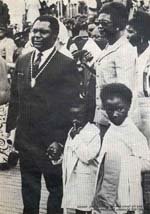


Tom Mboya arriving at Uhuru Park for what was to be his last Madaraka day June 1st 1969. He's with his wife Pamela and two children. At this point things were tough politically, but would he have guessed that he would be dead in about a month's time?


Tom Mboya at his prime. Cut down by anassasins bullets on the streets of Nairobi one Saturday afternoon, July 5, 1969 Posted by Hello


Today we start this much anticipated new feature that will lay bare the history of our beloved country of Kenya. For too long ago, the history we have read and accepted as the truth in schools has been a lie. Carefully crafted lies to please the powers that be. One of the reasons why we are in such serious problems in Kenya today is the fact that our founding fathers lost the way. Somewhere in their journey they abandoned the interests of the country for their own. This will come out very clearly in this series. Stay with us.

The single political assassination in Kenya that had the greatest impact is that of Tom Mboya."TJ" were his first two initials standing for Thomas Joseph. The son of a poor illiterate sisal picker in a colonial farm somewhere near Thika ,Tom Mboya rose to the top of Kenyan politics and was in line to be the first president of Kenya. Had he ascended to the Presidency, many political analysts are sure, things would have been very different and we would probably have avoided many of the mistakes that were made.

But I am getting ahead of myself. Let me get on with the story. I want to start my story from the end and then flash back. I believe that this is the best way of telling it.

5th July 1969. Kenya had recently celebrated its’ sixth anniversary of internal self rule (Madaraka day) the previous month on June 1st. Kenyans were optimistic in those years and were working hard to build their young nation and ensure a better future for their children. Little did they know that there were serious problems and infighting amongst their key rulers which was about to explode on the streets this sunny afternoon.

It was a Saturday like any other in the city center in Nairobi. Nairobi in those days was a neat nice place to be proud of and the overcrowded bustling streets were yet to come. It was lunch time and Kenyans were going about their business unaware of the fact that the history of their country was about to be irreversibly changed in a very dramatic and bloody way.

Minister of Economic Planning and MP for a Nairobi constituency Tom Mboya left his office for the weekend. He released his driver and body guard and headed for Chaani’s chemist along Government Street (Moi Avenue today). This chemist is still there today. He was driving his white Mercedes.

If he was carrying the day’s newspapers (like he liked to do) he would have had a copy of the East African Standard with him. On this broadsheet there was a photograph of him on page 1. It showed him striding confidently along the runway at Embakasi International airport where he had landed from Ethiopia Addis Ababa. He had been there for official business.

As he parked the car, he would not have noticed a short bald man with a brief case walking slowly towards the chemist where the cabinet minister was about to enter. He bought his usual prescription medicine for a nagging skin ailment and had a hearty chat with the Asian couple who owned the chemist. He had known them for years.

Outside the bald man in a brief case waited.

Mboya stepped outside the chemist and there were two extremely loud bangs of a revolver going off. Tom Mboya fell back on the glass door of the chemist. Blood oozing out of his fatal wounds in the chest and head.

He was rushed to Nairobi hospital in an ambulance but was pronounced dead shortly after arrival. By about 3pm that afternoon the remains of Tom Mboya were in the City Mortuary along Ngong Road.

The country was in shock. Who had killed Mboya and why? A state funeral was quickly organized even as violence broke out on the streets of Nairobi, President Jomo Kenyatta personally issued a statement in radio and TV saying the usual things. No stone would be left unturned to bring Mboya’s killers to book and the other usual **** about the dead man being a fallen hero and all. He lied to the whole nation when he knew very well exactly who was responsible for Mboya’s brutal killing and more important why he had been murdered. Or rather the personal cause for which he had had to lose his life.

Ironically probably the only man of Kikuyu descent who was allowed to set foot on Rusinga Island to attend the Mboya funeral the following weekend was another Kenyan by the name of Josiah Mwangi Kariuki or JM Kariuki. He had been Kenyatta’s private secretary before he fell out with the old man. He did not know it but barely six years later he would also be assassinated, for the same cause that his good friend Tom Mboya had just died for. His murder would be much more painful and he would have his private parts cut out (it is widely believed that this was done while he was still alive). His body would be found badly burnt by acid and with his private parts stuffed into his mouth. A clear message that he was silenced for something he said (stay with us in this blog and we will get back to that later).

So Mboya arrested with his ancestors on Rusinga Island. Death had come too early, he was not yet even 40. But what a brilliant political career he had had in his very short life. In fact he had almost become the first President and founding father of Kenya. Almost... Sadly “almost’ is never good enough and that is why this man is basically forgotten. Younger generations of Kenya do not know who the hell he was. They just know he got shot in the streets.

All this was of course deliberate and that is why the only full biography ever written on Mboya by a man who never met him a professor from University In Australia is titled, “Tom Mboya - the man Kenya wanted to forget.” David Goldsworthy’s book was published after President Kenyatta’s death in the 80’s.

The Kenya of that time or rather the leaders of the time were determined that Kenya should forget TJ as quickly as possible. Two new presidents have come since that beastly incident - Moi came and went and now Kibaki is president. Both these two Kenyans know the truth that you will discover in this blog over the next few days. But they’ve done nothing. Why?

And you Kenyan reading this, what are you going to do about this thing that helped drive your beloved country to the dogs? Think about that very deeply.

This is for you TJ, I never met you but from all that I’ve watched and read and studied on you, it is like I did. This is for you and a better Kenya, which you would have liked.

WHAT WOULD LIFE BE LIKE

WHAT WOULD LIFE BE LIKE….

I wish I was more of a man,
Have you ever felt that way,
If I had to tell you the truth,
Am afraid I have to say,
That after all I’ve done and failed to do,
I feel like less than I was meant to be.


What if I could fix myself?
Maybe then I could get free,
I could try to be somebody else,
Who is better off than me,
BUT I need to remember this,
that is when I am at my weakest.

I can clearly see He made the lame walk
the toungue-tied talk,
He opened blinded eyes,
Set the sun to rise from the east,
He knows my deepest desperate need in the world full of heart aches
I wonder what life would be like if we let Jesus live through you and me.

What if you could see yourself through another pair of eyes,
What if you could hear the truth instead of all familiar lies,
And what if you could feel inside the power of the hand that made you and me,
What would life be like.

TALK WITH GOD


TALK WITH GOD
How can I give what I don’t have,
How can I love if I don’t have the love for you that you desire,
How can I want what I don’t need,
Do I see how your heart bleeds,
the one thing that I see is your love for me.

I talk with God asking him a lot,
About the words that I didn’t want to give,
Ten a million questions just one answer,
He says “Don’t fight your battles; I am here to do it”.

How can I live up to my dreams,
How can I find what it all means?
When you show me that all you want is to be my first LOVE.

When I need to talk, when the world is against me
You hold me in your embrace,
Wipe all my tears, fight all my enemies
And you give me the answer
I LOVE YOU, CHILD.